Many people now find their house in Italy before they ever stand in it. A listing, a video tour, a call with an agent, and suddenly there is a stone farmhouse or an old town apartment that needs a new life. The question that follows is a practical one: how do you shape a home from another continent?
This is how we approach a renovation when the client lives far away. It is not a shortcut. It is a way of working that keeps decisions clear, keeps the house honest and keeps you close to the project even when you are thousands of kilometres from it.
Before you buy: look past the photographs
The best moment to bring in a designer is before the deposit, not after. A short review of the plans, the photographs and the listing can tell you much more than the price per square metre.
- The structure. Roofs, floors and walls in older Italian houses are often sound but tired. What matters is whether the bones allow the life you imagine.
- The light. Orientation, window sizes and thick walls decide how a room will feel in July and in January.
- The rules. Historic centres and protected landscapes limit what can change outside. Inside, there is often more freedom than people expect.
- The surroundings. Access for builders, distance to suppliers and local craftsmen shape both the schedule and the budget.
How a remote renovation unfolds
Distance changes the rhythm of a project, not its substance. We organise the work in clear stages, each one closed with a decision you can make from home.
- First conversation. A video call about how you want to live in the house: seasons, guests, work, the rooms you will use most.
- Survey. A site visit to measure, photograph and understand the building. Everything is shared with you in drawings and images.
- Concept. A first proposal for layout, light and materials, presented online and refined together.
- Design development. Detailed drawings, finishes, furniture and lighting, with samples sent or shown on camera.
- On site. Regular updates during the works and visits at the key moments, so that what is built matches what was decided.
Between these stages, the most important tool is simple: a shared, written record of every decision, in your language.
Permits: ask early, plan around them
In Italy, most renovation work is declared to the municipality before it starts. Depending on what changes, this can be a simple notice or a fuller procedure (CILA or SCIA are the forms you will hear most often), filed by a professional registered in Italy. Protected buildings and landscapes add their own approvals.
For a buyer abroad, the advice is practical: find out at the start which works need which procedure, who will file them, and how long the municipality usually takes. The design schedule should be built around those answers, not the other way round.
Materials and climate: let the house stay Italian
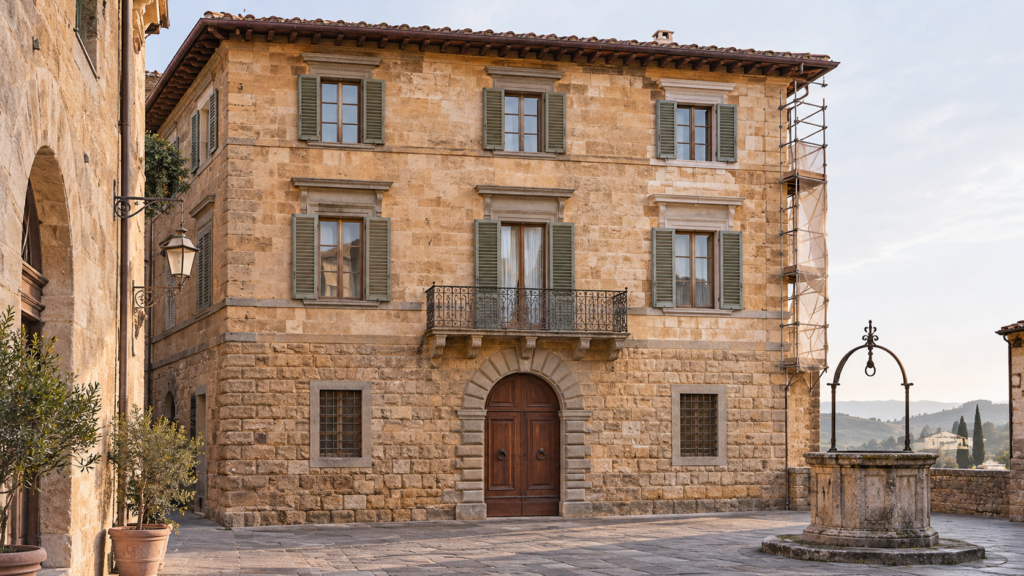
The houses people fall in love with in Italy were built for their climate. Thick masonry, shutters, deep reveals and shaded courtyards kept them cool long before air conditioning. After the summers of recent years, these are not decorative details. They are the first tools of a comfortable home.
We start from what is already there: lime plaster, stone, terracotta, timber. New layers, from insulation to lighting, should work with them rather than hide them. The result is a house that feels like its place and asks less energy to live in.
A house you shape from afar
Buying in Italy from abroad is a leap. Renovating from abroad does not have to be. With clear stages, honest drawings and a steady line of communication, a house can become yours long before you move in.
If you are looking at a property, or have just signed for one, we are happy to talk it through. Get in touch